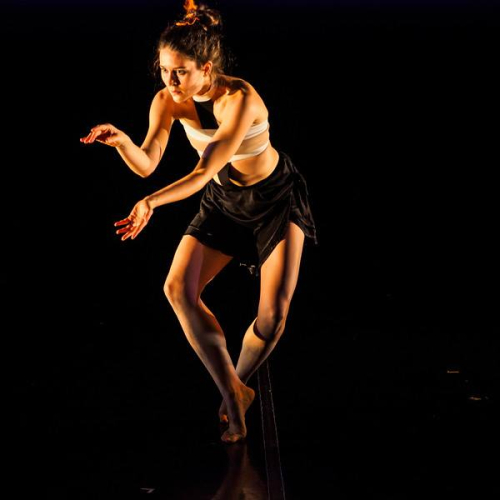
Hilary Snider in "The Magicians & The Crocodiles." Photo by Swagato Basumallick.
Saint Mary’s College MFA in Dance Program presents
Rooted
Dance Mission Theater, San Francisco
January 27th, 2018
By Heather Desaulniers
What comes to mind when you consider the term "rooted?" For me, it conjures words like grounded, self-assured, confident, planted, informed and drawn. Images of trees and of flowers; of vegetables sprouting out of the earth. And physical processes too – the kinetic exchange that occurs between the body and the floor, where energy washes down and away while simultaneously flowing upward and outward.
The soon-to-be-graduated 2018 class of Saint Mary’s College MFA in Dance candidates chose this evocative term to title their recent concert of excerpted and in-progress performance at San Francisco’s Dance Mission Theater. In the program notes, Concert Director Rosana Barragán shared that the students, “have elected to reflect on their roots and what 'rooting' or 'rooted' means to them.” The eight pieces on the program (from students in one of two tracks – Creative Practice or Design & Production) certainly embodied this intention. Rootedness was everywhere – in narrative and in compositional structure/form; in sound; in sets and in props. But I think the most telling takeaway of the evening was the dualism the students found in the work – much of it had an inner, personal rootedness, to be sure, but it was also percolating within a much larger lens.
Opening the first half of the program was Hilary Snider’s Maps & Meridian Part II: The Magicians & The Crocodiles, a trio for three dancers. When I encounter a bold title like this, I often go right to the narrative(s) possibilities, be they linear, deconstructed or conceptual. Though here, it was Snider’s physical syntax that struck; this was an essay in groundedness and weight, very apropos to the program’s theme.
Maps & Meridian Part II: The Magicians & The Crocodiles opened with the three dancers in distinct facings and planes: one on the floor, another in a phenomenal headstand and the third entering the space from up left. Choreographically, the movements were diverse – lunges, pliés, yoga postures, bourées, forced arch poses, strength in stillness, countertechnique lifts and balances. But the common thread of weight and groundedness underscored every part of the work, binding the steps, gestures and phrases together. And Snider was able to aptly communicate the process I described at the beginning, doing so within a theatrical container. Maps & Meridian Part II: The Magicians & The Crocodiles posited weight and being grounded as an exercise in counter forces. In the lifts and balances, you could see the performers equally giving and receiving weight. In the relevés, you could see the bodies channeling the down and the up to gain stability. In the headstand, you could see the connection with the floor and the pull toward the sky.
Summer Logan took the space for her solo Washed, a pitcher placed in front of her, downstage center. As she walked towards the pitcher, she sang the first line of “Amazing Grace." Reaching it, she poured water into a ceramic bowl, and began repeatedly washing her hands and arms while continuing to repeat the first line of the song. At first, the washing was gentle, therapeutic, almost a ceremonial sacrament, but quickly, it escalated in intensity and speed, eventually sending Logan off her axis into a forced body arch. Taking a moment to center herself, Logan returned to the bowl and the singular vocal phrase. And in the last moments of Washed, moved onto to the next line in “Amazing Grace," which ends with the lyric "me." A lone word that, with its presence, personalized the entire experience.
This work was steeped in rootedness, a rootedness that crossed many artistic dimensions. First, the frame of water (as well as the vessels used for the water) provided a link between the body and a fundamental, essential element. But the more powerful rootedness in Washed was Logan’s use of repetition as a compositional tool, not just in the movement but also in the various other facets of the solo. There was repetition in the vocals, there was repetition in the physical task of pouring water and washing, there was repetition in how she interacted with the pitcher and the bowl. The repetition transformed everything Logan did in the piece into a mantra, a meditation, a home, a root. And structural repetition in performance also has a deliciously wonderful effect of providing emphasis and anesthetic at the same time.
A second solo followed, Elements, choreographed and performed by Stephanie Brumer. Brumer walked on the diagonal from downstage left to upstage right, her hands caressing her back and resting on her forehead, postures that suggested soothing and comforting. The gaze was pulled to the hands in these first few seconds, and as Elements developed in the space, the hands remained a focal point. They came to the shoulder, setting off a dramatic circle of the arm. The choreography accumulated and grew, turbulence and ferocity taking over: the arms swinging like the hands of a clock, limbs in frenetic, full-range motion, the body and the spine joining in the charged physicality. Through all of this, the hands had an undeniable sense of calm, their staid quality meeting the chaotic forces, somehow managing to provide a sense of place, while the body swirled around like a tornado. Brumer navigated these opposing states, and in doing so, uncovered their surprising concurrency.
Elements felt like an introspective exploration, like Brumer was taking a personal emotional inventory. But while in that posture of looking inward, she had also designed a dance that, with its egalitarianism, was entirely relatable. Elements contained technically challenging choreography, but there were also gestures and steps that anyone in the audience could identify and understand. There were physical metaphors of time and everyday activities like walking. And I’m sure that many can relate to the atmosphere of tranquility amidst wildness that had been created. Brumer brought the viewer on her journey, but also opened her journey to the viewer as a shared experience.
With Carving a Niche, choreographer Surabhi Bharadwaj examined rootedness as an active, evolving practice, by contemplating the past and present as well as the individual and the collective. Costumed in traditional Indian dress, four women entered the space and began cycling through Bharatanatyam (a classical Indian dance form) choreography with its subtle eye movements, precise head motions, delicate finger patterns, and quick successive turns. Though the movements weren’t solely Bharatanatyam. Bharadwaj injected some unexpected surprises into the phrases – large poses in attitude derrière, jumps in parallel passé and turned out grand pliés in first position. But Carving a Niche wasn’t attempting to fuse genres; instead, it was encouraging traditional and contemporary vocabulary to be in conversation with each other. In doing so, Bharadwaj revealed a broad choreographic rootedness, shaped by both tradition and modernity, and indicated that this physical rootedness is in progress, changing and developing as the ancient and contemporary continue to intersect.
Carving a Niche’s unison choreography spoke of rootedness in community, while there were equally potent statements of individual strength. As the quartet continued, each dancer had the opportunity to solo. They would emerge from the group to tell their story through gesture, movement and a recorded soundscore. Here was a rootedness in the self, a confidence and freedom in the telling of their personal narratives. These four solos also brought the tradition/modernity dialogue back into the mix, though this time with respect to the narrative. While each story was unique, they shared a common theme – how living in modern society may at times seem to contradict tradition, but in actuality, the two are far more consonant than dissonant.
During intermission, a trunk was placed downstage right, and adorned with champagne flutes and candles for Ashley Mott’s …to be continued…, the largest ensemble piece on the bill with nine performers. Mott’s stage design perfectly captured a sense of isolation and abandonment. One woman sat on the floor, surveying the table before her; the other eight stood around her, humming “Auld Lang Syne." Robert Burns’ lyrics, the glasses, and the candles immediately transported the room to December 31st. But it was not a festive scene of friends toasting the coming New Year. The woman seated was alone, the glasses were set, but no one else was there to use them. Perhaps the standing performers were the souls absent from her celebration. Or were they different aspects of her emotional being? Maybe it was a little bit of both.
One dancer broke away from the group as the others stood in a semi-circle facing outward. With her movements, she manifested the notion of struggle, pulling her hands downward into a fist. The dancer seated on the floor began to mirror these gestures and movements, though with a contemplative sedateness. More solos unfolded in …to be continued…, and eventually, the eight standing cast members all began moving through space, hands reaching to grasp something that wasn’t there, fingers tracing the space to create something tangible within the emptiness. And throughout the entire piece, the first performer continued subtly mirroring the choreography. This was where I saw the rootedness in Mott’s work. The mirroring was a link, a connection to and a way of remembering a particular person or feeling. A bit of an aside, but it’s also important to note that the stage never appeared crowded, not once. Choreographing nine movers in a relatively small space is an impressive feat, indeed.
A large, woven basket-like structure was set centerstage for KJ Dahlaw’s Coming Out. Coming Home. A queer mating dance., the only duet in all of Rooted. Riley Taylor stood in the middle of the basket and expanded her upper torso to the sky. Rain, water and nature sounds permeated the theater; Taylor’s serpentine torso and arms surging with the score. Dahlaw entered the picture from the side sliding on the back. Having crossed the stage in this one posture, Dahlaw stood and began spinning all around Taylor, changing levels and planes, completely untamed and free. The movement, the mood, the sounds – everything was primal.
Then Coming Out. Coming Home. A queer mating dance. shifted. Dahlaw and Taylor noticed each other and exchanged a series of “heys." From that point on, the two engaged in an intimate conversation, a conversation about sexuality, gender and identity. Using both text and movement, they asked each other questions. There was a curiosity, a desire to learn about the other’s experience. They craved a connection. The more they learned, the closer their physical proximity, until Dahlaw joined Taylor and both became rooted in the basket structure, their fluid movements echoing their fluid dialogue. Coming Out. Coming Home. A queer mating dance. struck as another deeply personal narrative, yet again, something bigger was at play too. While of course I can’t say whether Dahlaw intended Coming Out. Coming Home. A queer mating dance. to be prescriptive, it was for me. Here was an example and model for human interaction, a vulnerable conversation that happened without agenda, reflecting kindness and an ear to really hear someone else’s truth.
Next up was the only solo in Rooted’s second half, Innerself/Inherself, composed and danced by Emily Denham. The opening moments of the work found Denham downstage right, exploring a series of arm movements that gradually accumulated in scope. This accumulation carried on, the legs, upper body and core appropriating the movement of the arms, while also adding new physical information to the scene. Denham rebounded from one facing to another, reaching, falling and turning with her eye glued to the horizon. She went on to experiment with her movement phrases (which incidentally were the best danced of the evening) along various stage circuits and different pathways, traveling in a straight line, facing directly front, moving in an arc, etc.
With its investigative spirit, Innerself/Inherself felt like a quest for understanding, a chance for Denham to consider what factors and what perspectives meld together to make up one’s roots. She was mining the stage in discovery, looking for what felt right and true. Denham would venture forward with telling anticipation, wondering what a new trajectory might reveal, and then, in contrast, would reverse back along the diagonal, returning to or revisiting something in the past. And in a beautiful cadence, Denham showed that her search for roots was still an ongoing process. Like taking a deep breath, she reached up in a glorious parallel relevé, and took a single step forward about to embark on another experimental course.
Closing the Rooted program was Laura Natario’s In Transit, an ensemble work for six dancers. Aptly titled, this piece was all about the in between space; being on a path but not yet at the destination; the act of being in transit. Natario took a deep dive into this concept with her choreographic phrase material. One dancer cycled through In Transit’s first sequence – a calm, legato mix of vast arms and long extensions. The arms reached out and away, legs stretched to arabesque. This same quality would reappear at several points in the work, sometimes as a solo, a duet or near the end, interpreted by all six dancers – each time the broad head, neck and shoulder port de bras coupling with limbs pointing outward. These movements were transitional in nature, traveling along a path; searching for an ending point that was somewhere in the distance.
And there was a major design element that also brought Natario’s concept to life. As In Transit began, a door lay on its side, industrial sounds and street noise pervaded the air, the stage lights dim. As the lights slowly warmed, you could see that the door had some damage, two large marks and dents. When on a journey, one likely encounters an array of doors and avenues, some of which may not look very good at the outset. But who knows what opportunities these doors might provide? In Transit’s door offered even further insight. A dancer emerged from behind the door and together, she and the first soloist stood the door upright. They let go and the door fell. They caught it before it hit the ground, stood it back up, let go again and of course, it toppled. The door was not attached to anything; it wasn’t grounded; it had no frame. It too was "in transit," in the process of finding its rooting.
—-
Heather Desaulniers is a freelance dance writer based in Oakland. She is the Editorial Associate and SF/Bay Area columnist for CriticalDance, the dance curator for SF Arts Monthly and a frequent contributor to several dance-focused publications.
—————–
 MFA Dance in Review
Leave a comment